
Reading time: 6 minutes
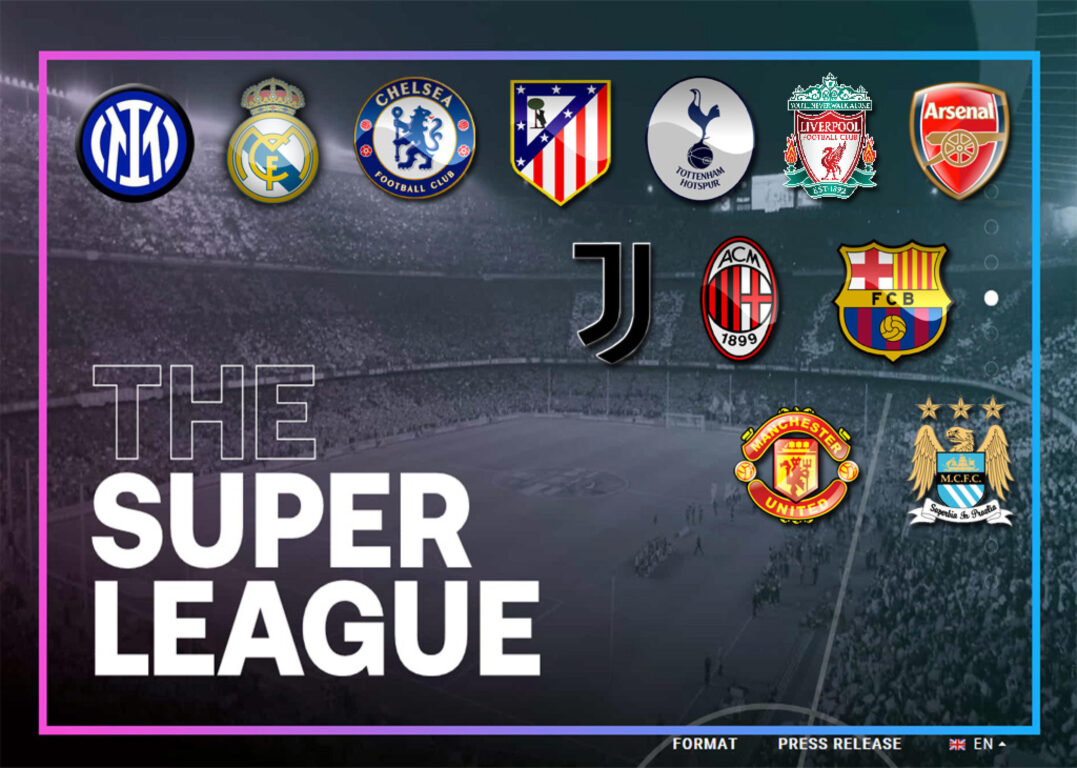
It was 3:04 PM last Sunday when Tariq Panja, a journalist for the New York Times, posted a tweet sharing his article titled: “Top European Soccer Teams Form Breakaway League.” This was followed by the most chaotic, confusing, and complex days in recent European football history, full of threats, official statements, positions, protests, and public debates.
After 48 hours, which seemed like an eternity, the Super League project collapsed in a loud and dramatic manner. Through five questions, we try to provide the keys to understand what happened.
1) Why was the Super League created, and why now?
The Super League, or the autonomous European competition for elite clubs, is not something new. It has been informally discussed for at least thirty years. A 1988 article from Corriere della Sera is circulating, where Silvio Berlusconi, then the newly elected president of AC Milan, spoke about a very similar project to the one we saw recently. The pandemic, with all it meant for the football world, was probably the spark that made the project take concrete shape, and the main reason, as often happens, is purely economic: the so-called top clubs are in very stormy financial waters, with excessive debt, decreasing revenues, and ever-high costs. Through the Super League, these teams would have had total control over the competition, without going through UEFA, which, in the eyes of the clubs, takes a slice of the pie that is too large for its actual contribution. It’s likely that the Super League operation was an attempted coup aimed at overturning the institutional hierarchies of European football, with the central issue being competition management: Why, as Real Madrid or Juventus, should I let UEFA take a large portion of the TV rights for my games, where players I pay millions of euros per year play, when I could take it all myself?
2) Where did the founding clubs go wrong?
Mainly in their communication. For two days, no one clearly understood what the competition was about, and many were confused, thinking it would replace national leagues. There was no unified press conference where all the presidents of the involved clubs answered the hundreds of questions that such an event inevitably provokes. There was no marketing campaign to launch and develop this product. No agreements were made in advance with TV networks to broadcast the new tournament. The method for assigning the five non-fixed spots wasn’t clarified. No market research was done to understand how the public would react to this revolution.
Since for fans, football is more than entertainment and spectacle, it’s also history, culture, and tradition, the message was sent that this was the death of football itself. To the public’s eyes, it seemed like a break driven purely by personal interests, with no regard for the outside world, and as a result, it wasn’t positively received by almost anyone: players, coaches, journalists, and especially fans. Furthermore, recent statements have shown that some key figures within the clubs, such as coaches or managers, were unaware of the situation. Although in some cases these words might seem unconvincing, the fact remains that the decision to create the Super League was made by the owners or presidents of the clubs, with little regard for the rest of the football world.
3) Would the level of spectacle really have increased?
For the owners of the “secessionist” clubs, certainly: more games between the best players, more goals, more spectacle, and, potentially, more money in their pockets. We still all remember the spectacle of PSG vs Bayern. But are we sure that such an increase in big matches wouldn’t have led to an overdose, followed by a subsequent normalization of these encounters? It’s a subjective question, where there are no right or wrong answers. However, it’s important to remember that the equation “stronger players = more spectacle” doesn’t always hold: how many boring finals do we remember? Matches like Liverpool vs Tottenham two years ago or Chelsea vs Atletico Madrid’s round of 16 this year come to mind. Strong teams don’t always equate to great spectacle. Football, even when played by the strongest teams, is a low-scoring sport where episodes change the game, and for most of the ninety minutes, not much spectacular happens.
If football is the most followed sport in the world, it’s not due to entertainment or show, but because of its much broader meaning in society, culture, and the sense of belonging fans feel.
4) Is the new Champions League that different from the Super League?
On Monday, April 19, the Champions League reform was approved, which includes an increase to 36 teams, two non-qualified teams through national leagues as wild cards, and a single group stage where each team only plays against 10 other teams out of 36. It’s clear that this reform wasn’t liked by the big clubs, who decided to form their Super League just twelve hours before the announcement of the new format for the old Champions League. But when we look at the details of what both competitions offer, they are quite similar in some key aspects: more games between big clubs, a single group stage instead of eight groups, and most importantly, the possibility of entering the competition without sporting merit.
This further proves that the attempt to create the Super League was more about taking control of European competitions, forcing UEFA to step aside, than creating a different competition in its format.
5) Will there be other attempts? What conditions might prevent that?
A lot depends on how UEFA, national federations, and clubs not involved in the Super League will behave towards the so-called founding clubs. It’s worth remembering that on Monday, UEFA was trembling at the thought of losing twelve of the fifteen richest clubs in the world, who own the majority of the world’s top players. The English clubs’ retreat, also spurred by political pressure, eventually led to the project’s collapse, but the threat was too great not to leave some impact on European football’s governing body. If UEFA were to respond too harshly, the separatist clubs would be willing to try again, having learned from their mistakes and ensuring there would be no backpedaling.
The path of dialogue, however, could guarantee more stability, at least in the short and medium term: a fairer revenue distribution in favor of those who invest more, an attempt to ensure a more balanced model of competitiveness, and reduced political influence in football seem to be good starting points to avoid further upheavals.
Written by Giacomo Panero
 BOCCONI STUDENTS FOR SPORT MANAGEMENT
Lascia un commento