
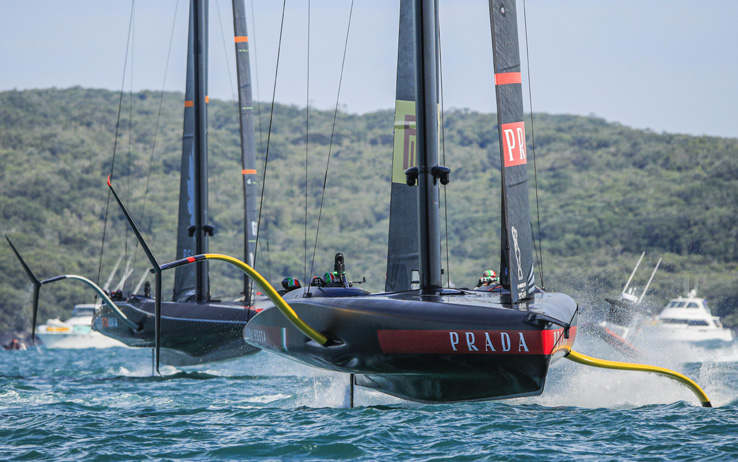
Last Sunday in Auckland, New Zealand, the first edition of the Prada Cup (formerly the Louis Vuitton Cup) concluded with the triumph of the challenger of record, Luna Rossa. The competition is one of the most coveted trophies in the world of sailing, but beyond the victory and inclusion in the hall of fame, the real reward of the Prada Cup is the long-awaited place in the challenge against the holders of the America’s Cup. The tournament, won by Luna Rossa, known as the “challenger series,” involves all potential challengers for the America’s Cup. This year, there were three: Luna Rossa, Ineos Team UK, and American Magic. However, after several thrilling round robins, a semifinal, and a final, the Italian team triumphed for the second time since the establishment of the challenger series, earning the precious chance to challenge Team New Zealand for the America’s Cup.
It’s hard to describe in a few words what the America’s Cup represents for sailing enthusiasts. The coveted prize, known by sailors around the world as the “Auld Mug,” is the oldest sporting trophy in the world. It has been up for grabs since 1851, 170 years ago, and symbolizes much more than just a reward. Winning the America’s Cup means entering history, deciding the venue and many of the rules for the next edition. For Luna Rossa, a victory against New Zealand could mean bringing the Auld Mug to Italy for the first time in history, hosting the next edition in the country.
Australian Alan Bond, who won the America’s Cup in 1983, the first year the trophy was not won by an American team, said: “Anyone who thinks the Cup isn’t about money is naive.” However, the “economic issue” Bond refers to does not concern the prize money for the Prada Cup, which doesn’t exist. No monetary prize is awarded for the challenger series, and the official figures for the America’s Cup are not made public. Without prize money, the question arises: how can teams finance the massive investments related to the boats, staff, and organizing the races?
The primary financiers are the sponsors. The races, thanks to their allure and spectacle, attract millions of viewers each edition, eager to support their favorite boats from home. The Cup thus represents a huge opportunity for companies looking to associate their brand with the triumphs of the boats. Looking at a picture of Luna Rossa, it’s easy to spot the two main sponsors, Prada and Pirelli, both Italian: in recent weeks, numerous Italian and foreign media have dedicated articles and published photos of Luna Rossa, thus providing significant visibility to the involved brands. The investment and trust of the sponsors in the team have thus been “rewarded” with a series of victories, first against American Magic and then against Ineos, leading to the triumph in the challenger series.
One of the most fascinating aspects of the America’s Cup is the evolution of the participating boats over the years. The sailing boats used in this edition are an unprecedented engineering masterpiece: thanks to special appendages called hydrofoils, which create lift, the boats can “fly” above the water. Much like the wings of an aircraft, the carbon fiber-covered foils allow the boats to reach speeds of over 50 knots. According to Bertelli, CEO of Prada and president of Luna Rossa, the America’s Cup “is not a regatta, but a technological development where the race is just the final process.”
As one might easily imagine, the investments for the design and construction of the boats for this edition were enormous. The team that spent the most was Ineos, with an investment exceeding 120 million euros. What makes Luna Rossa’s achievement even more surprising is the budget difference with the challengers: the Italian team spent less than half of what Ineos UK spent, around 60 million euros, the same amount as Team New Zealand.
The charm of this competition lies even in these numbers: analyzing the expenses and “on paper,” Ineos should have had no problem beating Luna Rossa, but there are many variables in a regatta, and thanks to a formidable crew and the design of a fast and manageable boat in any wind conditions, Luna Rossa was able to earn the opportunity to challenge the defender for the coveted Cup.
Starting March 6, the world’s eyes will be on Auckland, where Luna Rossa and New Zealand will fight for a place in history. The first team to win seven races will take home the Auld Mug and decide where the next edition will take place.
Will Luna Rossa manage to bring the America’s Cup to Italy for the first time?
 BOCCONI STUDENTS FOR SPORT MANAGEMENT
Lascia un commento