
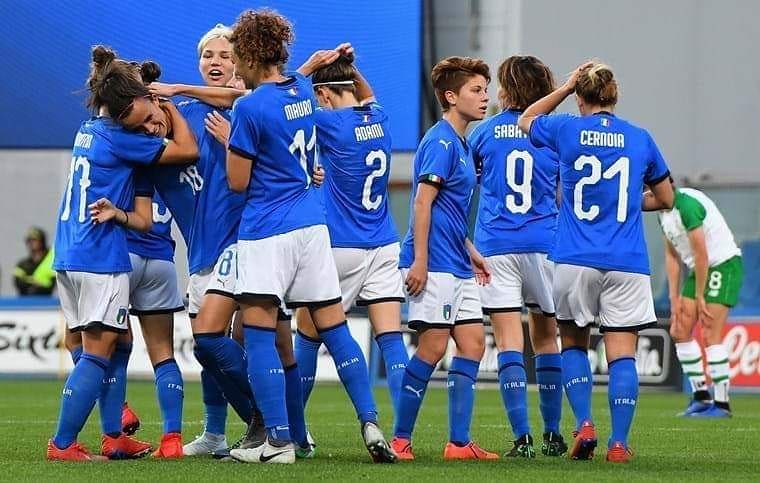
Starting from June 7, in less than 10 days, the Women’s World Cup will kick off in France. So far, nothing unusual, except that Italy will be participating in the competition for the first time in twenty years. This is certainly an extraordinary achievement, but can we talk about exponential growth in the movement, or is it simply a matter of luck? I would confidently lean towards the first option, and this article aims to explain the reasons why.
First, a bit of history. The first edition of the Italian Women’s Serie A championship took place in 1968, organized by the newly founded Italian Women’s Football Federation, with the same rules as the men’s league. However, unlike the men’s league, the teams that won the championship have alternated more frequently over the years, with 27 different teams lifting the trophy, including Torres with 7 victories. Furthermore, for many years, teams from cities where the men’s team often played in lower divisions participated and won, such as Torres, Alaska Lecce, Trani 80, and Reggiana, each with three championships.
Moving to the present, the situation has transformed in recent years: in 2017, Atalanta partnered with ASD Mozzanica, and the same year, Juventus took over Cuneo Femminile, winning the last two editions with Juventus Women. In 2018, Milan took over Brescia Femminile, a team that has been consistently at the top of the league in recent years. At the same time, smaller clubs such as Torres have disappeared, leading to a league with many women’s teams from male Serie A clubs (Juventus, Milan, Fiorentina, Roma, Sassuolo, Atalanta, Chievo), all of which have significantly larger budgets.
This shift has naturally led to growing interest in women’s football from all angles: attendance at matches has increased, reaching up to 40,000 spectators who watched the Juventus-Fiorentina match at Juventus Stadium last March. Television viewership has also grown, with many matches being broadcast by Rai and Sky. The latter, in particular, will broadcast all the matches of the Women’s World Cup, a clear sign that major broadcasters are strongly investing in this emerging product.
The growing financial interest in women’s football will inevitably lead to the final major step needed for international competitiveness: the entrance of women’s teams into the professional category. Currently, these teams are classified as “amateur,” with contracts offering a maximum salary of €30,000. This, of course, discourages the arrival of internationally renowned players, whose presence would further raise the level of domestic leagues, creating a virtuous cycle that would generate even more interest and financial growth in women’s football.
In conclusion, the Women’s World Cup starting on June 7 and culminating with the final in Lyon on July 7 is an opportunity to discover the world of women’s football by supporting the Italian national team in the most important competition, and once and for all, breaking the prejudices and clichés surrounding this constantly growing reality.
Credits to Matteo Ghioni
 BOCCONI STUDENTS FOR SPORT MANAGEMENT
Lascia un commento