

José Mourinho is one of the most successful managers in football history. A controversial figure, loved by many and hated by just as many. Praised by fans for winning trophies with their clubs, yet criticized by opponents who were often drawn into his psychological warfare. There is no middle ground.
One of the key moments during this Christmas period was his dismissal, accompanied by harsh criticisms from his former players. Is this the end of the Special One’s era?
Looking at the cold numbers, it seems so. A club’s wage bill is often the most accurate indicator of its final league position, and based primarily on this, his adventure at the red side of Manchester can be considered a failure. The average £6.5 million per year paid to each player in the squad is among the highest in world football, yet despite this, the Portuguese manager was unable to achieve the goals set by the club’s management.
Furthermore, even considering the financial resources made available by Manchester United to their manager, the results were not up to expectations. Over the last two and a half seasons, Mourinho managed to win 3 trophies, with the Europa League as the crowning achievement, but all the successes came in his first season. Too little, given the €466 million spent on acquiring players who were supposed to help the Red Devils make the decisive leap in quality. Despite these expenses, under his guidance, players like Paul Pogba and Romelu Lukaku struggled to express their full potential, even finding themselves on the bench in some matches. This management of players, considering the hefty financial outlay, contributed to growing discontent within the club’s hierarchy, creating more enemies for Mourinho.
As a result, despite the promising start, the gap with rivals, especially Manchester City, grew even wider after a strong first season. So what can explain these recent disappointing results?
The world of football, as we know, is in constant evolution. In particular, managing relationships with players has become a key aspect of a team’s daily activities. In some ways, Mourinho is a manager who has remained true to his original self, the authoritarian coach who does not hesitate to harshly criticize his players. This approach, which from the outside seemed like a lack of trust in his squad, only further damaged internal relationships.
His resistance to change has effectively distanced him from the elite of the world’s best coaches, relegating him, at least for now, to a secondary role. Meanwhile, the ones who are currently impressing are Josep Guardiola and Jürgen Klopp. The former has reinvented himself after winning everything at Barcelona, teaching football both in Germany at Bayern Munich and currently at Manchester City. The Liverpool manager, on the other hand, after arriving as an outsider and reaching the Champions League final last year, is now setting the pace in the league. Klopp is the prototype of the modern coach: tactically, he practices a fast, vertical game starting with high pressing, but even more importantly, he maintains strong relationships with his players, defending them even in difficult times.
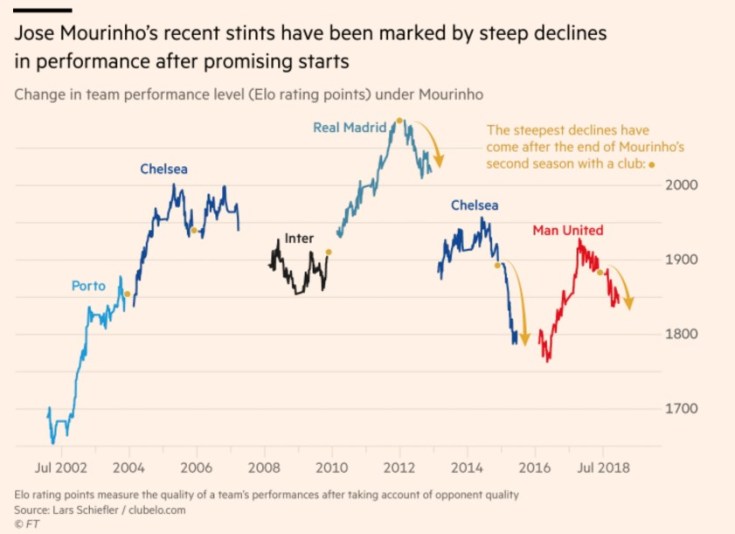
Even analyzed by the Financial Times, José Mourinho’s career has followed a pattern of promising starts at his new ventures, followed by a decline after the second season. This “curse” has repeated itself in his English adventure, culminating in his dismissal. Presumably, now begins the final part of his career. There is still time for a significant stint at a top club. His desire for redemption and his motivation will be high, but will it be enough to return to winning major trophies consistently?
Credits to Sergio Brigo
 BOCCONI STUDENTS FOR SPORT MANAGEMENT
Lascia un commento