
The 2022/2023 Serie B season will be remembered as one of the most competitive in recent years. With prominent teams like Genoa, Cagliari, and Parma, which have recently played on much bigger stages, the current championship has not only brought several technical innovations but also highlights a substantial balance, confirmed by a gap of only 6 points between the playoff and playout zones. But this Serie B season will also be remembered for the presence of 6 former Azzurri footballers who were protagonists in the 2006 World Cup final, played on July 9, 2006, at the Olympic Stadium in Berlin, where Italy triumphed over France in a penalty shootout (5-3) after extra time. The World Cup-winning national team included: Cannavaro, Gilardino, Inzaghi, Grosso, and De Rossi, who are now coaches in Serie B, as well as Gianluigi Buffon, who is playing for Parma.
Among the surprises of this year is Fabio Grosso’s Frosinone, which, with 39 points, secured the title of winter champion, leaving behind the revelation Reggina coached by Pippo Inzaghi and the Genoa team of Alberto Gilardino. Upon closer inspection, the term “surprise” in this case is more of a colloquial misunderstanding, rather than a result of a specific strategy that was devised and executed in detail by owner Maurizio Stirpe and sporting director Guido Angelozzi. In fact, looking at recent history, in the 2021/2022 season, Frosinone played a campaign far below expectations under Alessandro Nesta, who was sacked on March 5, with the team in 12th place in the standings. A few days after the dismissal, on March 23, Fabio Grosso took over. Amid general confusion, he was unable to reverse the situation, finishing the regular season in 9th place, thus missing out on the playoffs.
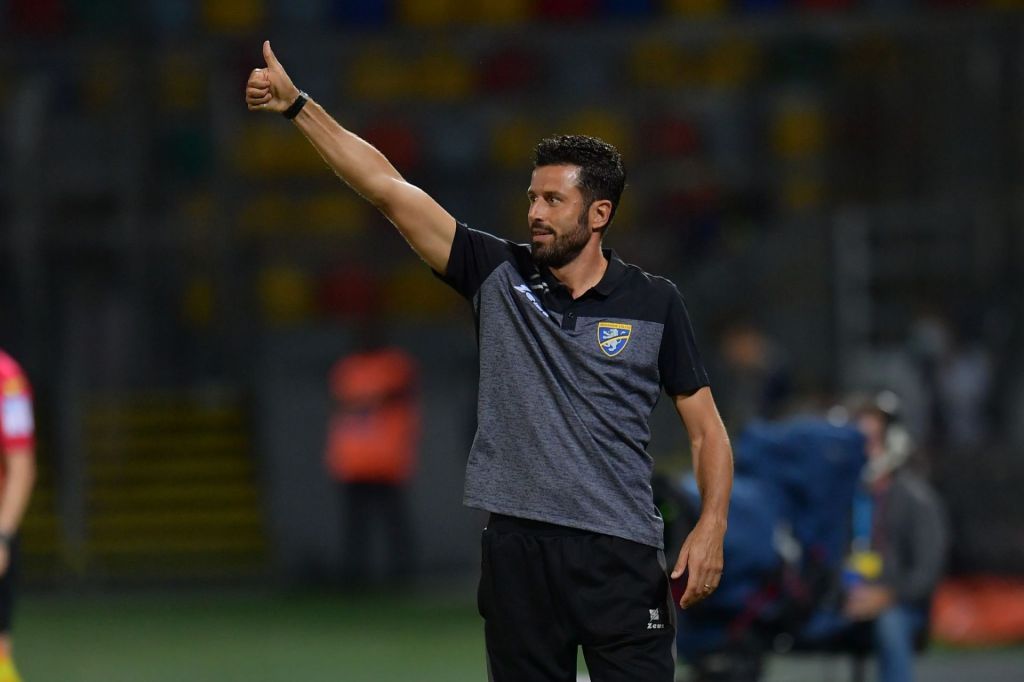
Let’s now focus on the coach: Fabio Grosso, a historic World Cup champion, has been one of the most discussed coaches in recent years. After good results leading Juventus’ youth team, he struggled to find his footing between Bari and Verona in Serie B and later in Serie A with Brescia. During his first Serie A stint, he lasted only 3 matches (all losses) before president Cellino called back his predecessor Corini. After his experience with Brescia, he took the hot seat at Sion, a team in the Swiss Super League, where he was sacked in March 2021, leaving the team in second-to-last place. After a series of negative experiences, he got the chance with Frosinone, but, as mentioned earlier, was unable to complete the season in the playoff zone. This is where the turning point came, with the intervention of owner Stirpe and General Director Angelozzi, who pursued a path that, today, is becoming increasingly rare: they showed trust in the coach and gave him the time (and the right conditions) to connect with the team. After a fluctuating season, Grosso’s Frosinone, which started as an underdog, finished the first half of the season in first place.
Turning now to the transfer market, the ideas of sporting director Angelozzi quickly became clear: create a mix of youth and experienced players (used to fighting and winning in these categories). Starting with the goalkeeper, 20-year-old Stefano Turati was brought in on loan from Sassuolo, and after a couple of anonymous seasons following his Serie A debut, he found his dimension. In defense, Frosinone added: Fabio Lucioni, born in 1987, fresh off promotion to Serie A with Lecce; right-back Mario Sampirisi, who won the playoffs with Monza and is also a specialist in promotions; and Gianluca Frabotta, who, after a season start full of misunderstandings with Lecce, was thrown into the team in Frosinone. The midfield, on the other hand, was the least revolutionized: already filled with good players like Garritano, Rohden, and Boloca before the market, they added Luca Mazzitelli and Ben Lhassine Kone on loan from Monza and Torino. The most interesting moves came in attack, where Frosinone took a bold gamble on young, talented prospects by bringing in Luca Moro and Samuele Mulattieri on loan, and signing Giuseppe Caso and Roberto Insigne. Specifically: Luca Moro, born in 2001, who had an outstanding season with Catania in Serie C; Samuele Mulattieri, who had a strong start with Crotone before slowing down but still showing flashes of brilliance; and Giuseppe Caso, an incisive playmaker who contributed to Cosenza’s survival in the previous season. In short, the strategy was clear: strengthen various positions with carefully planned acquisitions, focusing on youth and avoiding excessive spending.
Finally, let’s analyze Grosso’s tactical plan. Frosinone usually plays with an attacking 4-3-3 formation, with key points being: the midfielders’ insertions, fullbacks overlapping to cross towards the core of the game, and the attacking wingers cutting inside on their stronger foot. One of the key players is certainly 1994-born Luca Garritano, who, with his 2 goals and 5 assists, became the most influential player for the Lazio team. A quality midfielder, he is accompanied by Rohden (an expert at making runs into the box) and 24-year-old Boloca, forming a midfield capable of scoring goals that, combined with those from the attacking line, helped the team finish first. As for the attack, the rotation between Mulattieri and Moro has been vital, with 6 and 3 goals respectively, plus the usual contribution from Roberto Insigne (also with 3 goals). With Frabotta and Sampirisi on the flanks (left and right), the defense is led by the charismatic captain Fabio Lucioni, usually accompanied by Szyminski, all positioned in front of goalkeeper Turati.
In one of the most challenging Serie B seasons in recent years, Frosinone is leading with a clear idea of football and a well-defined club vision, and now it will be up to them to continue on this path.
 BOCCONI STUDENTS FOR SPORT MANAGEMENT
Lascia un commento