
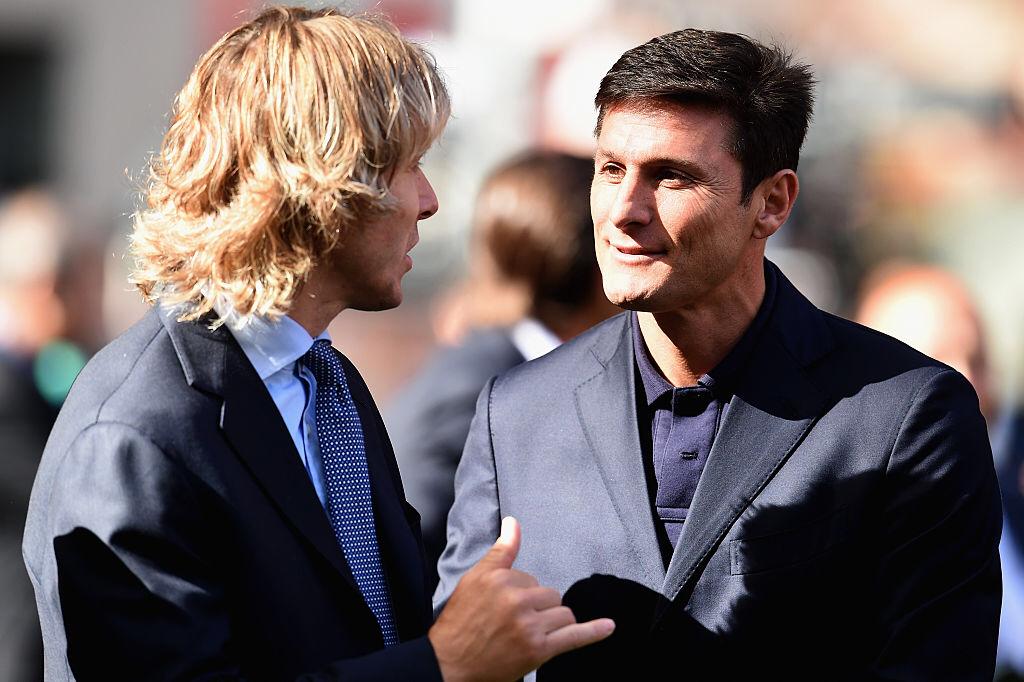
From Van der Sar, CEO of Ajax, to Nedved, member of Juventus’ Board of Directors, passing through Zanetti, Vice President of Inter, Totti, Leonardo, Tare… what careers!
“…Whatever role one has to take on, it requires serious training, both for people coming from University who enter our company and for footballers who leave the field and join the organization.” These are the words of Andrea Agnelli during the press conference announcing Buffon’s departure from Juventus last May.
The concept of managerial training was similarly expressed by Francesco Totti in 2017 when he joined Roma’s management: “I will try to make myself available in every area, from the youth sector to the president. Then, it’s normal that it will take six months, a year, two years—I don’t know how long it will take to establish myself in the role I truly prefer.”
Zanetti, who was appointed Vice President of Inter in 2014, is well aware of this. He has had several interactions with SDA Bocconi (which offers an executive sports management course) to prepare himself for the role of a high-level executive.
Indeed, within sports organizations, which are increasingly comparable to large multinational companies, the growing need to balance the football aspect with the more business-oriented one is becoming increasingly apparent. Therefore, on one hand, there is the temptation to include charismatic club legends in the management structure, but on the other hand, there is the obligation to form competent and specialized figures in the many areas that make up the daily management of the club.
Recently, thanks to Ajax’s remarkable run in the Champions League, Edwin Van der Sar’s rapid and successful career as an executive has attracted significant attention. After joining the club in 2012, shortly after ending his career at Manchester United with over 180 appearances in 6 seasons, Van der Sar started as the marketing director. He was soon promoted to general manager, and by 2016, he became the CEO. His rapid rise could soon see him return to Manchester in the role of Sport Director, according to current rumors.
Igli Tare’s career at Lazio is also one marked by rapid growth. Fluent in six languages, he was appointed coordinator of the technical area in 2008 and quickly became Sporting Director, playing an essential role in Lotito’s plans. In 2015, he was awarded the “Italian Sport Awards.”
What Role to Take?
Just as a champion on the field understands which spaces to occupy, to perform as an executive, it is necessary to find the most suitable position. “I want to be an important figure for Roma and for the Roma club, and to truly understand what I would like to do,” exemplifies this concept well. After two years of “apprenticeship” within the reorganization process supporting Roma at the end of the season, Francesco Totti already knows “what to change” and what decisions to make.
An emblematic case is that of Nedved and Trezeguet, former teammates on the field and now colleagues in the club. However, to highlight the need to understand which role best suits their profile, Nedved has been Andrea Agnelli’s right-hand man and a member of Juventus’ Board of Directors since 2010, while Trezeguet has been an ambassador for Juventus around the world for several years. The ability to leverage one’s image and fame to export the club’s brand worldwide will undoubtedly be one of the most significant fields in the future.
Leonardo, the current Technical Director of Milan, has certainly had a unique career. Aside from stints as coach of the two Milan clubs, he has been a transfer market consultant and emissary for Milan in South America. Before returning to Milan, he served as Sporting Director for Paris Saint-Germain. His experience, along with that of Paolo Scaroni, a prominent figure in Italy’s business world, will be vital for Paolo Maldini’s development, whose role is still not fully defined but extends beyond the sporting sector.
These cases, and many others like those of Giggs, Rafa Marquez, Rummenigge, and Bruno Conti, show how the combination of sport and business is becoming increasingly solid. For former footballers, carving out a space in clubs after hanging up their boots can only be achieved through a well-defined and targeted growth path.
Credits to Martino Bernocchi
 BOCCONI STUDENTS FOR SPORT MANAGEMENT
Lascia un commento