
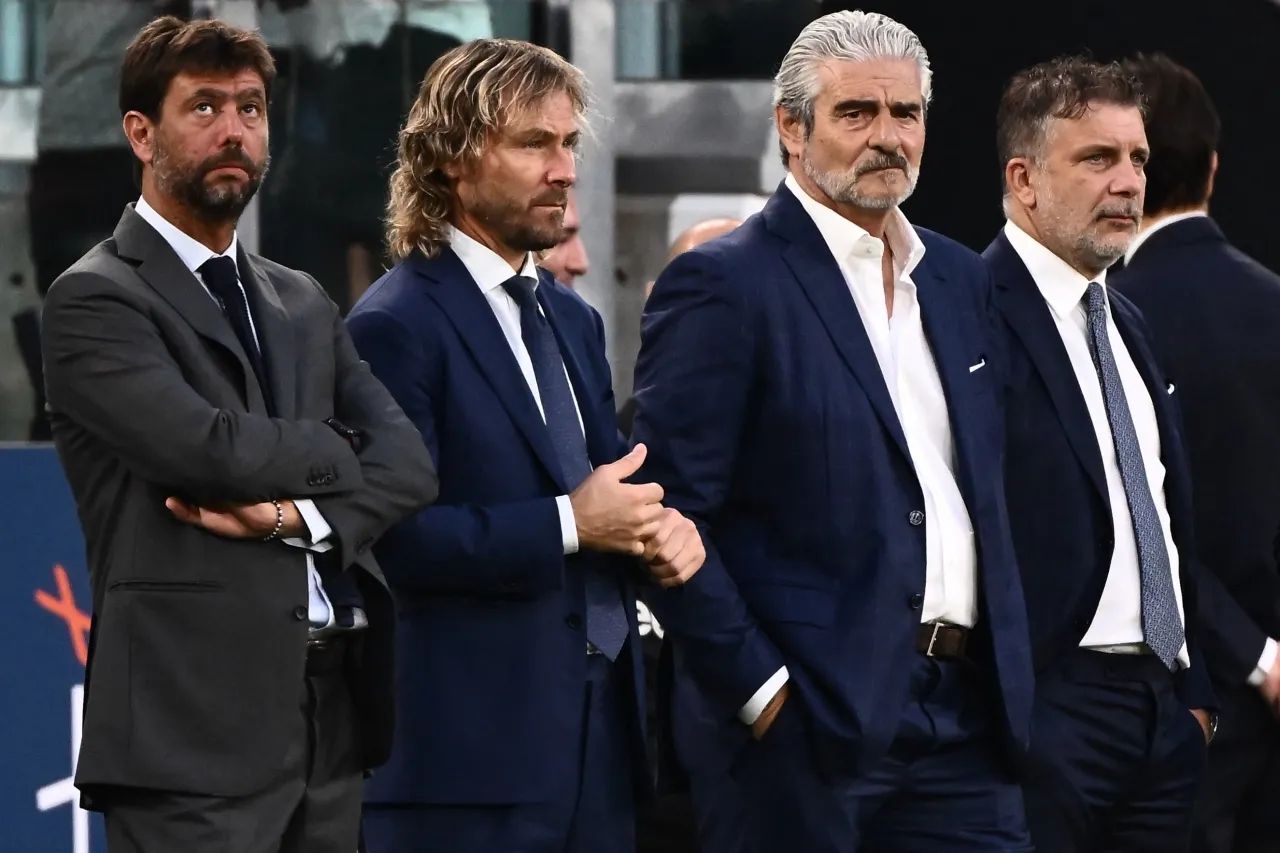
On January 19, 2023, shocking news shook Italian football and could potentially have repercussions across Europe.
The Federal Court of Appeal of the FIGC accepted the prosecutor’s request to reopen the “capital gains case,” thereby revoking the initial verdict and reopening the sports proceeding against the club. Juventus was penalized with a 15-point deduction in the standings, and sanctions were imposed on 11 of its executives. Among the sanctions, Paratici received a 30-month ban, Agnelli and Arrivabene 24 months each, Cherubini 16 months, and Nedved, Garimberti, Vellano, Venier, Hughes, Marilungo, and Roncaglio 8 months each. The court confirmed the acquittal of the other eight clubs involved (Sampdoria, Pro Vercelli, Genoa, Parma, Pisa, Empoli, Novara, and Pescara) along with their administrators and executives.
The case had initially been closed in previous months due to a lack of evidence proving the club’s guilt. However, the provision for case reopening under “revocation” allows a trial to be reopened if new facts emerge, or if existing facts that were previously unavailable are brought to light. If these facts had been known during the initial trial, they might have led to a different outcome. In such cases, the principle of ne bis in idem is overridden to uncover a new truth.
Although the reasons for the ruling have not yet been released, preliminary reports suggest that the penalties do not target individual transactions but rather the “system” allegedly implemented solely by Juventus. It seems the court deemed that Juventus’ modus operandi violated the principle of fairness (Article 4 of the sports justice code), as player valuations were not based on technical considerations but rather on “accounting cosmetics.” The court appears to have judged the situation with substantial severity. While the General Prosecutor of Turin had recommended a 9-point penalty, 15 points were ultimately imposed, likely reflecting the gravity of the evidence presented.
What is surprising is that the initial statements from Juventus executives, echoed within the club’s ecosystem, oscillated between conspiracy theories (suggesting political retaliation for the creation of the Super League) and victimhood (claiming “others did it too, yet only we are punished”).
However, the reality is more nuanced. It is clear that many sports clubs are currently grappling with significant economic difficulties, rendering the management of football clubs increasingly unprofitable due to rising player salaries, high operating costs, and revenue shortfalls exacerbated by the COVID-19 crisis. It is likely that several clubs adopted similar practices to balance their accounts. Yet, Juventus, as a publicly listed company, was subject to specific accounting obligations and principles that do not apply to other clubs, potentially leading to charges of false accounting.
Juventus has announced its intention to appeal. Within 30 days of receiving the full reasoning for the ruling, the club can file an appeal with the Sports Guarantee Board at CONI, which can only address procedural legitimacy rather than the merits of the case. The board may annul the ruling, uphold it, or remand the case to the court for a retrial. Subsequently, Juventus could appeal to the Lazio Regional Administrative Court (TAR) and then to the Council of State.
As of now, the points deduction has dropped Juventus to 10th place in the standings, tied at 22 points (now 23 after a draw with Atalanta) with Empoli and Bologna. With 15 points deducted, qualifying for the Champions League is now a challenging objective, and the club’s stock value has fallen by 8%, dipping below 30 cents.
Furthermore, UEFA is closely monitoring developments. On December 1, it launched its own investigation, based on the Prisma inquiry and the Consob probe, into possible violations of financial fair play. These violations may relate to the salary maneuver during the COVID-19 crisis. In September, Juventus had agreed to return within fair play parameters within three years, paying a €3.5 million fine, which could rise to €23 million if the commitments are not met. However, if Juventus is found guilty of falsifying financial statements under investigation—statements on which the settlement agreement was based—UEFA could impose heavy sanctions, including exclusion from European competitions.
Additionally, March will bring a ruling from the European Court regarding the Super League dispute.
On the salary issue, the so-called “Ronaldo Letter,” recently published by Corriere della Sera, has also come to light. Dubbed “the document that wasn’t supposed to exist,” it is now in the hands of the Guardia di Finanza and investigators examining the Juventus case. This “side letter” stems from the salary maneuver during the 2020–2021 season, involving fictitious waivers of monthly payments by some players. The document states that Juventus was to pay Cristiano Ronaldo €19.5 million as part of a Supplementary Bonus Agreement by July 31, 2021. However, this document was never filed with the Italian Football League. While Ronaldo himself is not at risk, and may choose to join the legal proceedings as a civil party, Juventus faces significant repercussions on this front as well.
This situation likely explains the decision by Agnelli and the entire board to resign months ago, an attempt to distance themselves from a scandal that has now erupted and shows no signs of dissipating. Meanwhile, the players, deeply affected by the situation, must demonstrate unity and resilience to overcome off-field challenges, especially for the true victims of all this: the honest and unsuspecting fans, who certainly do not deserve a football world once again tarnished, much like on that infamous December 14, 2009, when Calciopoli shook Italian sports.
By Antonio Spampinato
 BOCCONI STUDENTS FOR SPORT MANAGEMENT
Lascia un commento