
Before the Saudi Arabian project, several non-European leagues attempted to attract top players with heavy investments. A very famous example is Oscar’s transfer from Chelsea to Shanghai SIPG for 60 million euros and a substantial salary increase. However, all these efforts by these football leagues struggled to build durable and sustainable success.
The Arabic “Saudi Vision 2030”, instead, is proving itself more sustainable and competitive than previous attempts. It is no more targeting only established star players, but investments have been made also in infrastructure and youth development.
Criticism, Ethics, and Sportwashing
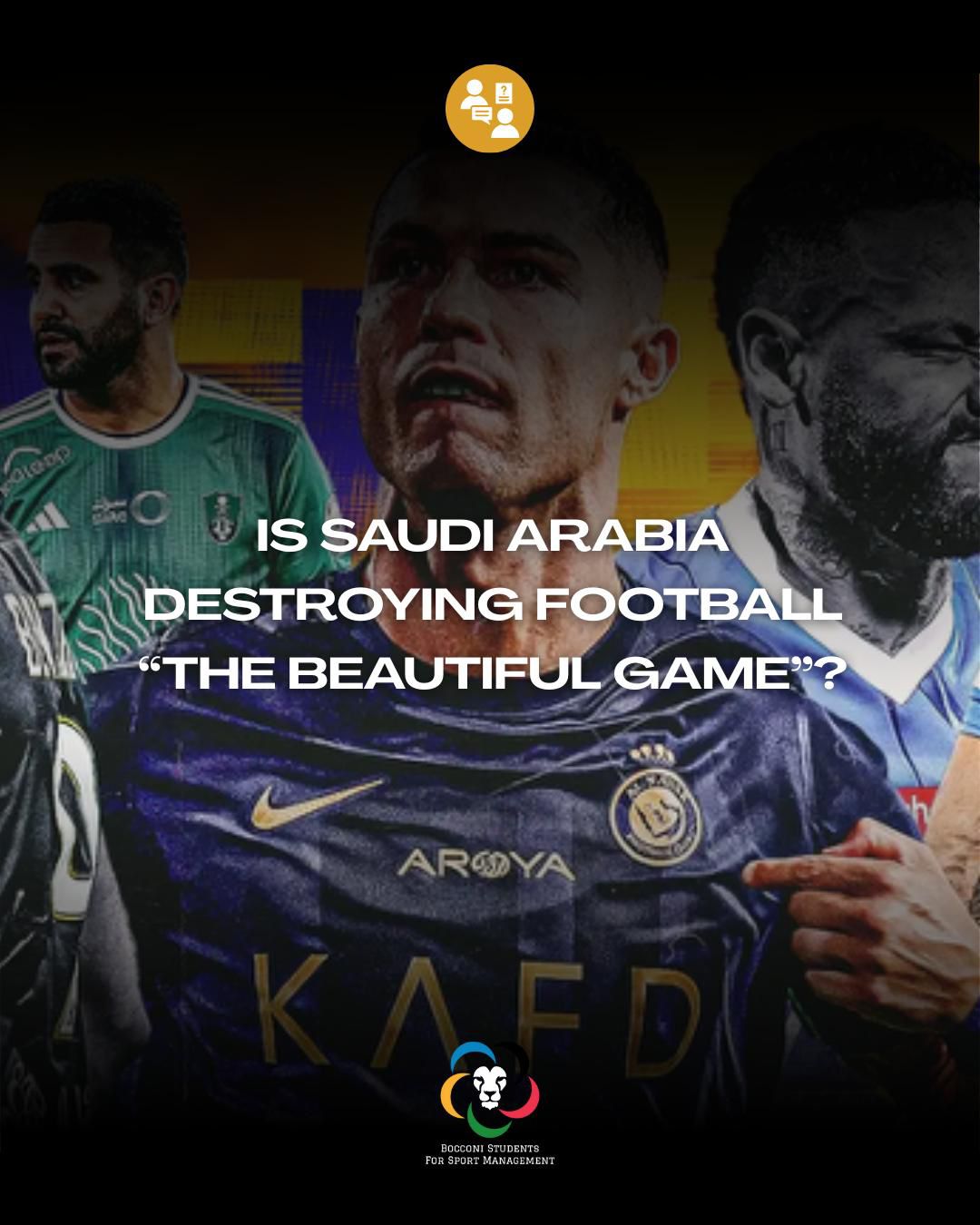
This movement has been harshly criticized by some players, such as Toni Kroos, and even more by supporters and commentators, who claim that this new reality is destroying football – ”the beautiful game”. But is this really the case?
To answer this question, it is necessary to start by understanding whether we want to take into account the ethical and moral aspects related to this project and to the Saudi Arabian government or not. There is no doubt that this huge project is part of a broader strategy of sportwashing that aims to improve the country’s international reputation. While Crown Prince and Prime Minister Mohammed bin Salman, who has governed Saudi Arabia since 2022, explained in an interview with The Guardian that his aim is to fight extremism, the country’s position towards human rights remains very concerning, as reported by Amnesty International.
The aim of this article is to assess whether this kind of project could truly damage football and if it represents a new phenomenon in the industry, leaving all ethical and moral considerations to the reader.
The Saudi Arabian project
In the recent transfer windows, Saudi Arabian clubs have signed star players such as Benzema, Kanté, Mané, João Félix, and many others. However, the most sensational transfer was that of the five times Ballon d’Or winner, Cristiano Ronaldo.
Although it might seem that these clubs are able to attract only famous players nearing the end of their careers, and that their project is just based on extremely high wages, this is not totally true. While the financial power has undoubtedly been a key leverage to bring many star players, the vision of the Saudi football project is not limited to the signing of big names.
Indeed, the transfers have involved younger players as well. In some cases, wonderkids with a bright future or, in others, players that were already performing at high levels in very relevant stages. Some examples could be, respectively, Gabriel Veiga, who, despite being heavily linked to Napoli, went to Saudi Arabia when he was just 21 years old, and top-level footballers such as Darwin Núñez, Jhon Durán, Mateo Retegui, Moussa Diaby, and Rúben Neves, who were signed when entering their peak. These players were key figures for some of the best European teams, and they were actively searched and requested by European top clubs, yet Saudi Arabian teams were still able to sign them.
When analyzing the Saudi movement, the focus cannot be limited solely on the transfers, but it is essential to understand their broader project. “Saudi Vision 2030” shows how development should come with important investments in structures and across the whole sector. Moreover, the nation has already been selected as host for the 2034 FIFA World Cup and has set a target to build 11 stadiums before the beginning. This shows how the project is ambitious and not limited to the signing of big names. Saudi Arabia doesn’t seem to aim just to receive short-term attention from the signing of these stars, but rather to become one of the major players in the industry. We don’t know yet if this will happen or not, but the path has clearly been set in motion.
Historical comparisons and parallelisms
The Saudi Arabian project is not something new, rather the opposite. During the 1950s and 1960s the Brazilian league was widely considered to be the best domestic league in the world, having players like Pelè, who is arguably among the five best players to have ever graced the field. However, then there was a shift that led Europe to become the most dominant and important football stage. Many South American talents moved to Europe, creating a significant gap between the two continents’ competitiveness. An example is Zico’s transfer to Udinese in 1983. At that time, Zico was among the bests, having won the Intercontinental Cup with Flamengo, yet he still joined Udinese, a mid-table Italian club. Europe offered greater economic stability and higher wages, leading South American top players to accept not only offers from European top clubs, but also from less competitive ones. During this period, players such as Maradona, Falcão, and many others went to Europe, earning substantially higher wages.
Even within Europe financial and competitive dominance has changed and shifted over time. While in the 1980s the Italian Serie A was the most competitive and richest league, being able to have players like Van Basten, Platini, Maradona, Zico at Udinese, and Hagi at Brescia, that position is now occupied by the Premier League. Currently, English mid-table teams are able to sign some of the best players in Europe. For instance, newly promoted Sunderland was able to sign Xhaka, who played a pivotal role in the Bayer Leverkusen’s Bundesliga-winning campaign, while Newcastle a few years ago bought Tonali, who was one of the best players of AC Milan. Moreover, players like Senesi and Todibo preferred to join Bournemouth and West Ham rather than traditional Italian top clubs.
Conclusion
These examples show a clear pattern: in football, as in many other industries, there will always be leagues or clubs with greater financial resources and competitive power. Therefore, what is happening with Saudi Arabian football can be considered something not new nor unusual. As Argentinian former footballer, coach, and manager Jorge Valdano said: “Europe must remember that they have been the Saudi Arabia of the last 20 years, draining the most important continents of all their talents”.
Finally, if one wants to question Saudi Arabia’s approach, then the discussion should focus on the ethical implications of sportwashing and on the country’s position towards human rights. From a purely football perspective this phenomenon is neither new nor unique.
by Marco Ernesto Fugazza
 BOCCONI STUDENTS FOR SPORT MANAGEMENT
Lascia un commento