

The current football season will feature a major innovation: the introduction of the new FIFA Club World Cup format, which will take place in the USA between June 14 and July 15.
The previous format involved the six reigning champions of the main confederation competitions, who competed in single-elimination knockout matches. In the last edition, Real Madrid was crowned world champions after defeating Mexico’s Pachuca 3-0 on December 18, 2024, at the Lusail Iconic Stadium in Qatar.
The new format is completely innovative compared to the previous one and follows that of the World Cup for nations: there will be a total of 63 matches thanks to the expansion to 32 teams, divided into 8 groups of 4. The top two teams from each group will advance to the knockout stage, which includes the round of 16, quarterfinals, semifinals, and final.
All matches will be available exclusively on DAZN, selected as the exclusive global broadcaster, and in Italy also co-broadcast by Mediaset, which — thanks to a sublicensing agreement — will air one match per day on free-to-air TV.

How are the 32 teams selected?
Each Confederation has a predefined number of allocated slots, specifically distributed as follows:
- UEFA (Europe): 12 slots
- CONMEBOL (South America): 6 slots
- AFC (Asia): 4 slots
- CAF (Africa): 4 slots
- CONCACAF (Central and North America): 4 slots
- OFC (Oceania): 1 slot
An additional slot is granted to the host Confederation, in this case assigned to Leo Messi’s Inter Miami, winners of the 2024 MLS Supporters’ Shield.
Slots are allocated to the clubs that have won the top-tier competition of their Confederation (UEFA Champions League, AFC Champions League, CAF Champions League, CONCACAF Champions Cup, Copa Libertadores, and OFC Champions League) up to the 2021 edition, or via a specific ranking system established by the Confederation the club belongs to.
The most prominent teams representing each Confederation include:
- UEFA: Real Madrid (winners of the 2022 and 2024 Champions League), Manchester City (2023 winners), Chelsea (2021 winners), Bayern Munich, PSG, Inter, Juventus, and Atletico Madrid
- CONMEBOL: Palmeiras, Flamengo, River Plate, and Boca Juniors
- AFC: Al Hilal and Al Ain
- CAF: Al Ahly SC and Wydad AC
- CONCACAF: CF Monterrey and Seattle Sounders FC
- OFC: Auckland City FC
Fifa World Cup 2025 prize money
According to a FIFA statement, the 32 participating teams will compete for a total prize pool of $1 billion, with the winning team earning up to $125 million. More specifically, the prize money will be distributed based on two criteria: participation ($525 million) and sporting results ($475 million).
The following table shows the detailed breakdown of how the prize pool will be distributed (in millions of dollars):
| PARTICIPATION | SPORTING RESULTS |
| European clubs: between 12.81 and 38.19, based on a ranking that considers sporting and commercial criteria | Group stage win: 2 |
| South American clubs: 15.2 | Group stage draw: 1 |
| North, Central, and Caribbean clubs: 9.5 | Qualification to the round of 16: 7.5 |
| Asian clubs: 9.5 | Qualification to quarter-finals: 13.125 |
| African clubs: 9.5 | Qualification to semi-finals: 21 |
| Oceania club: 3.6 | Runner-up: 30 |
| Winner: 40 |
Stadiums
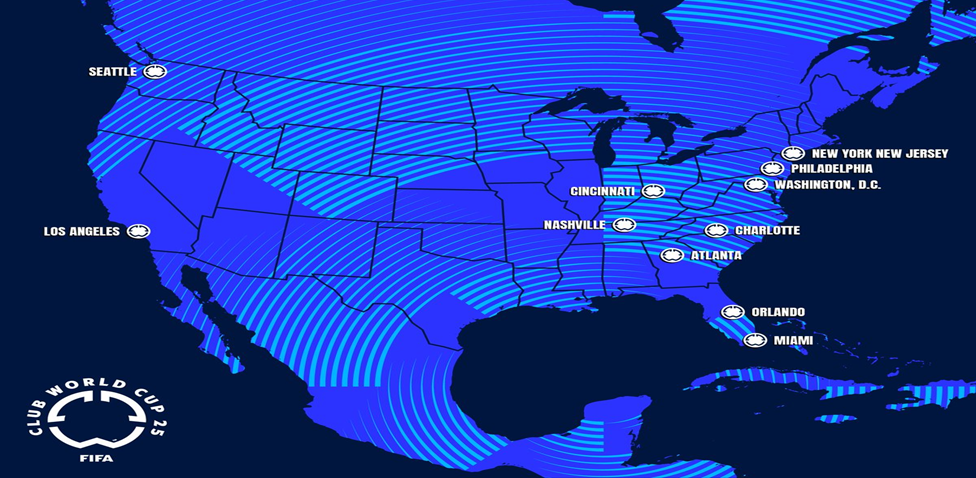
The FIFA Club World Cup, as mentioned, will take place in the United States, serving as a prelude to the 2026 FIFA World Cup for national teams, which will also be hosted by the USA in collaboration with Canada and Mexico.
The 11 host cities for the competition are mainly located on the East Coast, with the exceptions of Seattle and Los Angeles. Specifically, the cities are: New York, Miami, Atlanta, Washington, and Orlando – the latter hosting matches in two different stadiums, for a total of 12 stadiums.
The stadiums with the largest capacities are:
- Mercedes-Benz Stadium – Atlanta, GA (75,000 seats)
- Bank of America Stadium – Charlotte, NC (75,000 seats)
- Rose Bowl Stadium – Los Angeles, CA (88,500 seats)
- Hard Rock Stadium – Miami, FL (65,000 seats)
- MetLife Stadium – New York, NY (82,500 seats) – selected to host the final
- Camping World Stadium – Orlando, FL (65,000 seats)
- Lincoln Financial Field – Philadelphia, PA (69,000 seats)
- Lumen Field – Seattle, WA (69,000 seats)
Extraordinary Transfer Window
Finally, on the occasion of the World Cup, FIFA has introduced a new and unprecedented transfer market slot, active from 1 to 10 June.
One of the most debated issues revolves around the so-called “squad lists”, the players in each club will be allowed to register for the competition. The tournament will take place during the typical summer transfer period and close to the end of players’ contracts (late June), making this a particularly sensitive topic.
Each team will be able to register a minimum of 26 and a maximum of 35 players, including at least 3 goalkeepers. The final squad must be selected from a preliminary list of up to 50 names, submitted in advance. However, only 26 players may be included on the matchday squad list for each game.
As for transfers and expiring contracts, the regulations allow clubs to make up to 6 changes to their final squad between June 27 and July 3. This includes replacing players already on the list and adding up to 2 new players. Importantly, a player cannot participate in the competition with more than one club.
So, what kind of tournament should we expect? Will teams, and especially players, approach it with the right level of motivation and intensity? One of the key questions will be how energy levels are managed, particularly for clubs that reach the final stages: will they be able to adequately prepare for the new season, given that domestic leagues resume in August and recovery time will be limited to just a few weeks?
Maybe the real challenge will be just that: finding a balance between ambition, physical management, and strategic planning in a calendar that’s becoming increasingly packed with matches.
By Tommaso Villa
 BOCCONI STUDENTS FOR SPORT MANAGEMENT
Lascia un commento