
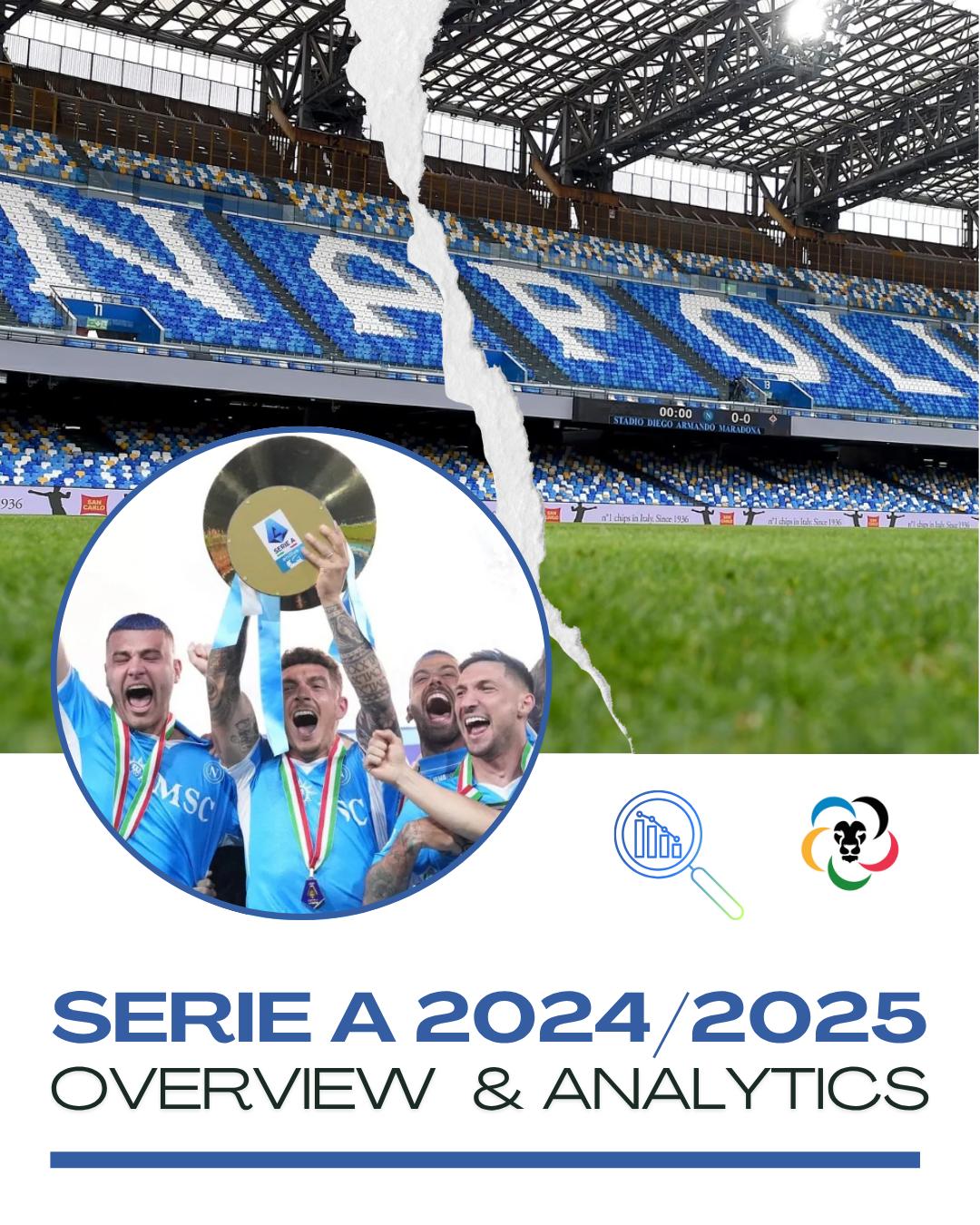
Final outcomes
Once again, the season of Italy’s top football competition has come to an end. Napoli have secured the fourth Scudetto in their history — their second in the last three years. According to the final outcomes, alongside Napoli, Inter, Atalanta, and Juventus will compete in the 2025/2026 UEFA Champions League, having finished second, third, and fourth respectively.
The race for the final Champions League spot remained open until the very last matchday: Juventus, with a 3-2 away win against Venezia, not only clinched qualification but also condemned the Venetian side to relegation and pushed Roma down to the UEFA Europa League 2025/2026. Joining the Giallorossi in Europe’s second-tier competition will be Bologna, thanks to their 1-0 victory over AC Milan in the 2024/2025 Coppa Italia final.
AC Milan and Lazio, following two disappointing seasons, will not participate in any European competition next season. The last available European slot goes to Fiorentina, who — with a record 65 points (their best performance since the 2012/2013 season, when they reached 70 points) — will once again feature in the UEFA Conference League 2025/2026.
Alongside Venezia, the teams relegated to Serie B are Monza, who with 18 points at least avoided setting the record for the lowest point tally in a 20-team Serie A with the 3-point win system (still held by Salernitana with 17 points last season), and Empoli, who failed to avoid the drop after losing 2-1 at home to Hellas Verona on the final day.
Fan engagement
Interest in Serie A continues to grow, as highlighted by the latest stadium attendance figures. The current season closed with an average of 30,824 spectators per match, confirming the upward trend of recent years and marking an event that hadn’t occurred in over two decades: for the second consecutive season, the average attendance surpassed the 30,000 mark. Last season, the average was slightly higher, at 30,911 spectators per match.
These numbers are reminiscent of the late 1990s, the golden era of Italian football, when between the 1997/1998 and 1999/2000 seasons, Serie A averaged 30,670 spectators per game. Following those years, Italian football experienced a steep decline, largely due to the scandals linked to the Calciopoli scandal. In the immediate aftermath, the league recorded a drastic drop, with the 2006/2007 season averaging just 19,307 spectators per match. Compared to that low point, the increase today stands at around +60% — or 11,517 more spectators per match, on average.
According to data collected by Transfermarkt, the just-concluded season saw a total of 11,662,951 spectators across all matches — a slight decrease of -0.73% (85,236 fewer) compared to the 11,748,187 from the previous season. This drop is largely attributed to the Genoa vs. Juventus match held behind closed doors on September 28.
Surprisingly, given their on-field performance, AC Milan * recorded the highest home attendance, drawing a total of 1,358,734 spectators to San Siro — including approximately 12,000 foreign fans per match. This is further evidence of football’s appeal as a driver of tourism. At the other end of the spectrum, the club with the lowest home attendance was Como, which attracted just 199,960 spectators over the season. This was in part due to the limited capacity of the Stadio Sinigaglia (10,524 seats), one of the smallest venues in the league.
In terms of stadium occupancy rates, the top-performing clubs were Cagliari and Juventus. The Sardinian side filled the Unipol Domus to 98% capacity, averaging 16,085 fans per match (out of a maximum of 16,365) for a total of 305,617 spectators over the season. Juventus recorded a 97% occupancy rate, with 764,498 fans attending matches at the Allianz Stadium — an average of 40,237 per game, with a total capacity of 41,507.
The club with the lowest occupancy rate was Fiorentina (47%), mainly due to the ongoing renovation of the Stadio Artemio Franchi. Despite a total capacity of 43,147, the stadium averaged only 20,358 spectators per game. Renovations are expected to be completed by the end of October. Meanwhile, Atalanta posted the highest year-on-year increase in stadium occupancy: from 59% last season to 91% this year, thanks to the completion of renovations at the Gewiss Stadium.
* The figures referenced in this paragraph refer to tickets sold per match, not actual attendance — which is not publicly disclosed. The most notable discrepancy between reported sales and visual impressions inside the stadium concerns AC Milan, which suffered from a “no-show” phenomenon: many season ticket holders opted not to attend matches in person due to disappointing on-field results.
Sponsorship & TV rights revenues
As we know, the main revenue streams for football clubs are: sponsorships, TV rights, matchday income, merchandising, and player trading or capital gains. Detailed information for each club, including the breakdown of these revenue sources, will only become available once the teams publish their financial statements as of June 30. However, what is already known are the revenues from main sponsors and the distribution of TV rights.
Leading the ranking for main sponsor income are Inter and Juventus, each generating €30 million from their shirt sponsors — Betsson for the Nerazzurri and Jeep and Visit Detroit for the Bianconeri. Juventus’ case is particularly interesting, as the club only secured these deals in the final weeks of the season, largely in anticipation of the upcoming Club World Cup. For most of the year, Juventus played with the Save the Children logo on their jerseys — a partnership that did not include any financial compensation.
Nonetheless, Italy’s top clubs remain far behind their European competitors such as Manchester City, Real Madrid, and PSG, whose sponsorship deals with Etihad, Emirates, and Qatar Airways respectively bring in between €70 and €80 million annually.
Here is the complete Serie A ranking by revenues from the main sponsors::
| CLUB | SPONSOR | MILLIONS (€) |
| Inter | Betsson | 30 |
| Juventus | Jeep & Visit Detroit | 30 |
| Fiorentina | Mediacom | 25 |
| Milan | Emirates | 19 |
| Roma | Riyadh Season | 12 |
| Napoli | MSC | 9 |
| Atalanta | Lete | 5 |
| Bologna | Saputo | 4 |
| Torino | Suzuki | 2,25 |
| Monza | Motorola | 2 |
| Parma | Prometeon | 1,4 |
| Udinese | Bluenergy | 1,2 |
| Genoa | Pulsee | 1,2 |
| Lecce | Deghi | 1 |
| Verona | 958 Santero | 1 |
| Empoli | Computer Gross | 0,8 |
| Como | Uber | 0,7 |
| Venezia | Cynar | 0,6 |
| Cagliari | Regione Sardegna & Moby | nd |
| Lazio | Nessun main sponsor | / |
Tabella 1: Juventus, Fiorentina and Bologna present as main sponsor a “related party”, that is, a company owned by the club’s owners.
Regarding TV rights revenues, their distribution is based on the Melandri Law (later revised by the Lotti reform), and is structured as follows:
- 50% is distributed equally among all clubs;
- 28% is based on sporting results (11.2% based on the final ranking of the most recent season, 2.8% on points earned in the most recent season, 9.33% on performance over the five seasons preceding the most recent one, and 4.67% on historical results);
- 22% is based on social engagement (1.1% tied to minutes played by young Italian players, 12.54% based on stadium attendance, and 8.36% based on TV viewership).
The most impactful metric related to sporting results is the league placement in the most recent season (11.2%). Therefore, based on the final standings of the just-ended season, the clubs have generated the following revenues:
| CLUB (IN ORDER OF RANKING) | MILLIONS (€) |
| Napoli | 15,7 |
| Inter | 13,2 |
| Atalanta | 11,3 |
| Juventus | 9,4 |
| Roma | 8,1 |
| Fiorentina | 6,9 |
| Lazio | 5,6 |
| Milan | 5,0 |
| Bologna | 4,4 |
| Como | 3,8 |
| Torino | 3,1 |
| Udinese | 2,8 |
| Genoa | 2,5 |
| Verona | 2,2 |
| Cagliari | 1,9 |
| Parma | 1,6 |
| Lecce | 1,3 |
| Empoli | 0,9 |
| Venezia | 0,6 |
| Monza | 0,3 |
By Tommaso Villa
 BOCCONI STUDENTS FOR SPORT MANAGEMENT
Lascia un commento