
Between England and Spain’s goal fests, Morocco and Croatia’s goalless draw, Qatar’s lackluster debut, and the shocking defeats of Germany and Argentina, one element has remained constant throughout this World Cup: controversy.
For months, if not years, major media outlets worldwide have been shedding light on the troubling issues behind awarding the World Cup to Qatar. From corruption within FIFA to the tragic, unquantifiable death toll of workers building the tournament’s infrastructure, the event has been shrouded in shadows. Leaving these broader themes aside for a moment, this article focuses on more recent and less widely debated developments.
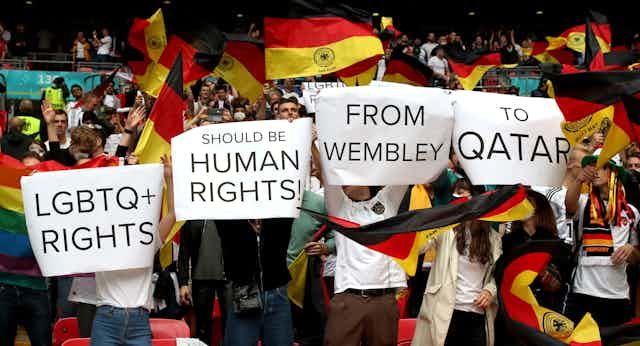
At the start of the tournament, FIFA threatened sanctions for any team captains wearing the rainbow armband in support of the LGBTQ+ community during matches. The penalty? A yellow card. Many European federations were forced to reconsider, worried about jeopardizing their players’ tournament prospects due to suspension risks after two yellow cards. However, these federations did not shy away from criticizing the decision.
One of the most striking responses came on November 23, before Germany’s match against Japan. The German team posed for their official pre-match photo with all 11 players covering their mouths—a powerful and symbolic image. The German Football Association shared the photo on Twitter, stating:
“With our captain’s armband, we wanted to embody the values of diversity and mutual respect. […] This isn’t about making a political statement; human rights are non-negotiable. […] Banning the armband is equivalent to silencing us.”
This act, coupled with German Interior Minister Nancy Faeser wearing the controversial armband in the VIP box, delivered a sharp rebuke to FIFA and its president Gianni Infantino. Notably, English ex-footballer Alex Scott also wore the armband on air as a BBC commentator days earlier.
Another contentious aspect surrounding this World Cup concerns the fans—or lack thereof. Social media has been abuzz with videos of “fake fans,” allegedly hired (some reports claim for payment) to parade in support of various teams. On November 22, La Repubblica described encountering a group of young men on the metro, all wearing mismatched gear—scarves, capes made of flags, and counterfeit jerseys representing four different teams. They spoke the same language and likely hailed from India or Nepal, regions from which much of Doha’s labor force is drawn.
Despite these attempts to create a lively atmosphere, the World Cup seems devoid of real fans. Streets and bars near stadiums often appear deserted, and stadiums themselves rarely seem full, despite official attendance figures claiming otherwise. The emptiness is visible even on TV broadcasts, with glaringly vacant seats contradicting FIFA’s statistics.
So, the question arises: was all this really necessary?
By Rodolfo Bianchini
 BOCCONI STUDENTS FOR SPORT MANAGEMENT
Lascia un commento