
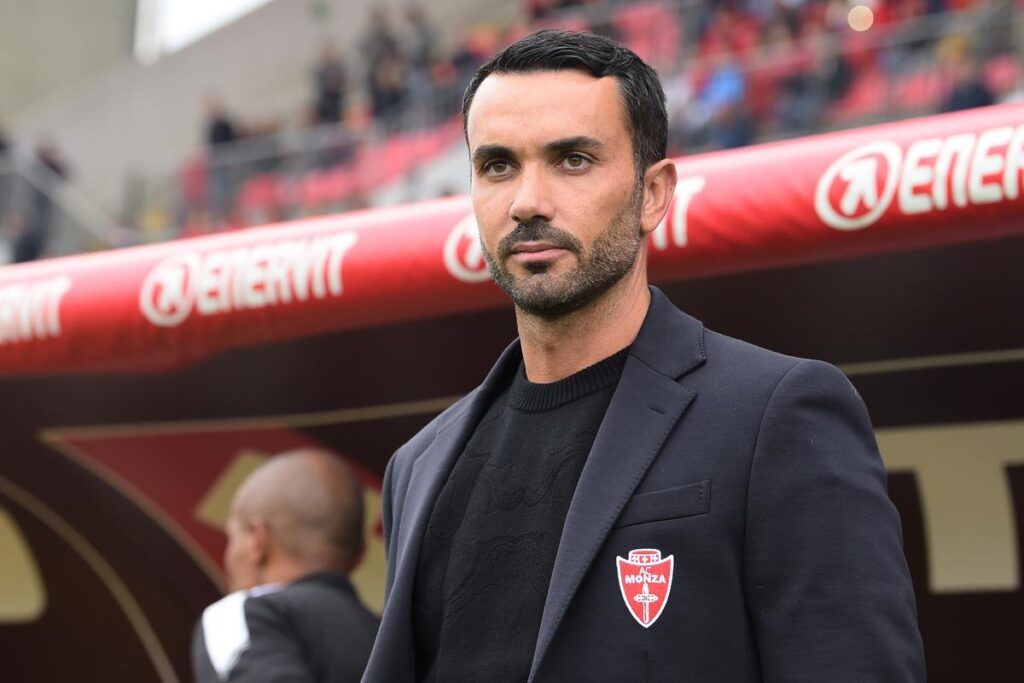
Monza is one of the most media-famous teams in recent years. In 2018, Fininvest fully acquired the team, then playing in Serie C, for around 3 million euros and, most importantly, appointed Adriano Galliani as CEO. Thus, the Berlusconi-Galliani duo, which for years made AC Milan fans dream, was reunited, now giving hope to Monza supporters. Indeed, after a relatively smooth four-year journey and transfer campaigns in the lower leagues enviable even to Serie A teams, Monza reached the top tier for the first time in its history.
Galliani confirmed Giovanni Stroppa as head coach and began assembling a squad aimed at securing a comfortable survival or even something more. Approximately 20 million euros were spent to build a team with a precise vision dictated by Berlusconi: a young, Italian, and competitive squad. With signings like Pessina, Sensi, Caprari, Petagna, and many others, an eleven began to emerge, composed of experienced and skilled players accustomed to the tactical demands of the Italian league. In short, the newly promoted side had excellent prospects, and in addition to its fans, a large group of sympathizers formed around the team due to the excitement generated.
After a hard-fought victory in the Coppa Italia against Frosinone, Torino, a hopeful and challenging opponent led by coach Juric, visited the Brianteo. Monza lost 2-1, possibly leaving too much depth and space between the lines to a team whose offensive strategy thrives on such gaps.
In the following matches, five defeats and a draw exposed difficulties Stroppa had already shown in Serie A with Crotone. Giovanni Stroppa, an Italian coach born in 1968, was in his third Serie A stint, having achieved promotion twice before with Crotone. He is considered a promotion specialist. His typical setup, a 3-5-2, emphasizes ball possession, wing play, and consistent presence in the opponent’s half. In possession, the central defender in the back three dictates the tempo and orchestrates ball circulation, the wide center-backs spread out, the wing-backs push forward, and midfielders exploit spaces between the opponent’s midfield and defense. However, this formation, as seen with Crotone, proved perhaps too offensive for Serie A. With the league’s higher pace, the delay in midfielders and wing-backs retreating after losing possession left vast spaces in Monza’s formation, which teams in the top division exploited ruthlessly.
Consequently, after five defeats, a draw, and 14 goals conceded, the relationship between Monza and Stroppa came to an end, leading to a casting call for his replacement. Many names were considered, including De Zerbi and Ranieri, but Berlusconi and Galliani ultimately opted for a less predictable solution: promoting Primavera coach Raffaele Palladino.
This decision surprised many Monza and neutral fans. Entrusting a young coach with no Serie A experience to manage a team embroiled in a relegation battle—was it the right move? Adriano Galliani vouched for Palladino, stating that “he has the makings of a great coach,” not a recommendation to be taken lightly. Thus, Raffaele Palladino, born in 1984, took charge of Monza’s volatile bench, facing a daunting challenge: a match against Juventus the following Sunday.
Regarding his coaching style, Palladino mentioned in his first press conference that he draws inspiration from Gasperini and Juric, his former coach and teammate, respectively. Their high-pressing, high-intensity approach has proven successful in Serie A.
What has Palladino brought to the table?
First, enthusiasm, bolstered by his first Serie A experience. Then, mental and defensive stability. Being very young (38 years old), nearly the same age as the players, and recently retired from playing, he has fostered a close, almost collegial environment, earning the players’ full trust. Moreover, by continuing with a formation similar to the one Stroppa had used for two years, Palladino found already established principles, particularly for the three-man defense.
What changed?
He transitioned from a 3-5-2 to a 3-4-3, sidelining Stroppa’s loyal players (Marrone and Molina) and opting for an experienced three-man defense and a striker who acts more as a penalty-area target man than one who roams across the front line. The main changes, however, were on the flanks. On the left, promising talent Carlos Augusto, who Stroppa often used as a central defender, moved forward, while on the right, Birindelli was replaced by Ciurria, a left-footed attacking winger deployed in an unfamiliar position to enable inverted crosses.
It was precisely this combination of initial enthusiasm and tactical adjustments that led Monza to its first historic Serie A victory against Juventus. How? With a 1-0 win, courtesy of a goal from a penalty-area striker (Gytkjaer) assisted by an inverted-foot cross from Ciurria.
Visionary or not, Palladino managed to uplift Monza players during a dark period, injecting the vital energy essential for any team, especially one battling relegation. Will it continue? Adriano Galliani assures us it will.
By Tavella Pietro
 BOCCONI STUDENTS FOR SPORT MANAGEMENT
Lascia un commento