
One year away from the official announcement, the names of the countries that will host the 2030 World Cup are already circulating, but Saudi Arabia can be considered the real winner.
Although it will still be a year before the official vote by the FIFA Congress, it is essentially decided: Morocco, Portugal, and Spain will organize the 2030 World Cup.
This will be the first time Morocco and Portugal host the tournament, and the second time for Spain, after the 1982 edition, a World Cup fondly remembered in Italy. The three-country formula will be repeated, following its debut in 2026 with Canada, Mexico, and the United States. Moreover, it will be the first World Cup held across three continents. To “best celebrate the Centennial World Cup,” FIFA has announced that three opening matches will be played in Argentina, Paraguay, and Uruguay. This unprecedented decision has sparked considerable debate.
The anger and astonishment of many, including “Football Supporters Europe,” the only fan group officially recognized by UEFA, which has called the 2030 and 2034 editions “the end of the World Cup as we know it,” stem not only from the environmental and logistical challenges for players and fans but also from the implications for the allocation of the 2034 edition. According to FIFA regulations, countries from confederations that have already hosted a previous World Cup are banned from submitting bids for the next edition. Effectively, only Asia and Oceania will be able to host the 2034 World Cup.
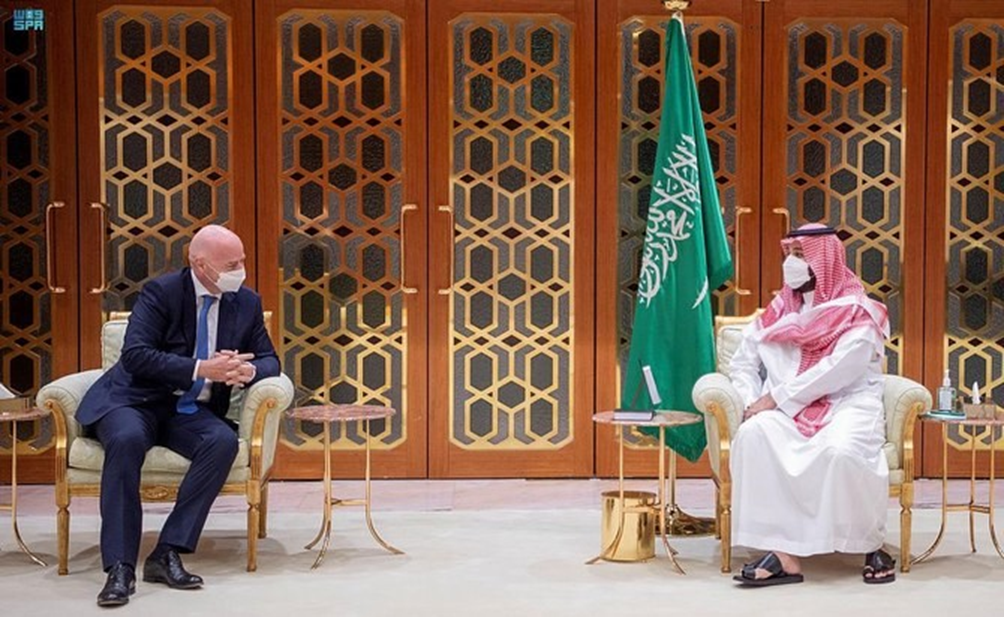
The response from the Saudis was quick. An hour after FIFA’s announcement, the Saudi press agency issued a statement in which Prince Mohammed bin Salman expressed his country’s interest in hosting the World Cup. With the backing of the president of the Asian Football Confederation, which includes Australia, Saudi Arabia is nearly certain to win the bid, following a joint bid attempt (which was later withdrawn) with Greece and Egypt for the 2030 World Cup.
The only obstacle to Saudi Arabia’s triumphant bid could be the uncertain Australian candidacy. However, it faces an almost impossible deadline of October 31, 2023, to confirm its interest in an unusually short process that will conclude with the final decision in 2024. Beyond the deadline, the Socceroos will need to partner with countries from New Zealand and Southeast Asia. They are also likely to be penalized due to hosting the recent Women’s World Cup.
If that’s not enough, the last World Cup in Qatar offers another clue: at the 2022 Qatar World Cup opening ceremony, Prince Mohammed bin Salman was seated next to Gianni Infantino… A goal with an open net?
By Federico Petrella
 BOCCONI STUDENTS FOR SPORT MANAGEMENT
Lascia un commento